
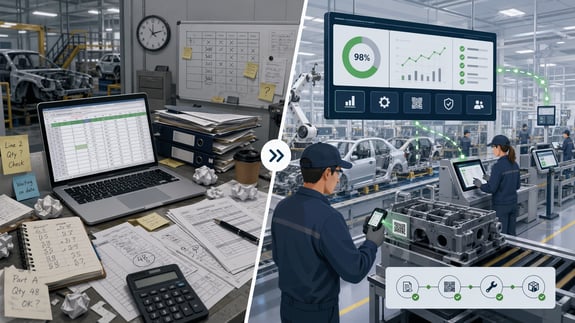
Replacing Excel in Production: How CIOs and IT Managers Can Make the Transition to Robust Shop Floor IT
Excel is so widely used in many plants not because it is the best production solution, but because it is readily available, everyone knows how to use it, and business units can solve problems with it without lengthy IT lead times. But this is precisely where the structural risk lies: a local stopgap solution gradually becomes a business-critical system—without robust integration logic, without consistent role and permission models, without a clean audit trail, and usually without clear accountability for operations, further development, and data quality. Production-related data is then generated in files, distributed via email or network drives, manually consolidated, and eventually written back into ERP, quality, or shop floor systems. This is not digital production, but digital improvisation. [Source: Mesa Blog]
Why now?
There are three reasons why this topic belongs on the agenda of CIOs and IT leaders right now. First, the need for real-time transparency in production, quality, and logistics is growing. MESA sums it up: Competitive manufacturing requires standardized and digitized information flows that extend beyond the “four walls” of the factory to connect with value-chain partners. Second, the pressure to scale is growing: the cloud, data platforms, digital twins, and industrial AI all require structured, integrated data. Third, governance and security requirements are becoming more stringent—especially in the automotive sector, where standardized information security certifications such as TISAX are relevant. Excel can support all of this, but it cannot carry the load. [Source: Mesa Blog]
The Hidden Costs of Excel
The hidden costs of using Excel in production are often underestimated. Usually, only the licensing costs are visible—and those are low. In contrast, the process costs remain hidden: duplicate data entry, status inquiries via phone or email, manual validity checks, error corrections, approval loops lacking transparency, delayed reports, and significant coordination efforts between production, quality, maintenance, and logistics. This was very evident in the Toyota Kaizen case: The process involved many individual files, and processing took an average of six weeks. After digitization, the average processing time dropped to one week; at the same time, the number of suggestions increased by 18 percent. This clearly demonstrates that the economic impact lies not only in the minutes saved, but in a higher organizational response speed. [See Case Study Kaizen]
The situation is similar with inventory and material processes. At the Toyota oil warehouse, analog boards led to low transparency, difficult inventory forecasting, and tedious updates. It was only the digital warehouse application, featuring a screen display and a scanner, that provided the necessary visibility and reduced the risk of incorrect labeling. The IHPL intralogistics solution took things a step further: production requirements, items, and material movements were digitally synchronized. The result was shorter wait times, fewer empty runs, uninterrupted production, and a significantly reduced need for storage space. Replacing Excel in such processes therefore not only digitizes documentation but also stabilizes material flow and supply reliability. [See Case Study Toyota]
Which architecture is best suited for which process?
The key question, therefore, is not: “What should we use to replace Excel?” The right question is: “Which architecture suits which process?” For simple yet plant-relevant processes such as Kaizen, action management, shift handoffs, or inspection workflows, a centralized web application based on a relational database—with a clear role model, audit logging, and APIs—is often sufficient. For production-critical processes involving traceability, recipes, order control, production data acquisition, or machine integration, an MES or MOM is the better solution. This is precisely where ISA-95, standardized data objects, and a clear separation between the enterprise level and the shop floor come into play. OPC UA, on the other hand, is a sensible standard when OT systems and machines need to be connected in an interoperable and secure manner. [See Vialutions Blog]
In this target architecture, low-code should be viewed as an accelerator, not a panacea. It is ideally suited for clearly defined, low-risk use cases that require frequent changes—such as mobile data entry, approvals, checklists, or supporting worker applications. However, it is not a good substitute for complex, highly integrated, and business-critical production cores if governance, security, lifecycle management, and integration are not professionally organized. This is precisely why Microsoft emphasizes vision, roles, security, governance, and automated auditing for enterprise low-code; Vialutions additionally points out limitations regarding integrations, external stakeholders, and long-term operating costs. For CIOs, this means in concrete terms: Low-code, yes—but only with guardrails, a Center of Excellence, and clear boundaries. [See Vialutions Blog]
The target architecture of leading OEMs also follows this exact logic. Mercedes-Benz connects around 30 plants via a data platform, creates virtual representations of production processes, and uses digital twins and AI in new production runs; Volkswagen is now rolling out more than 100 applications across more than 40 plants via its Digital Production Platform; BMW relies on digital twins, over 100 digital applications, and real-time quality monitoring with AIQX. Behind these examples lies not a single tool, but a pattern: standardized platforms, reusable integrations, centralized data models, and scalable rollouts. This is precisely why the true end of Excel in production is not the introduction of a new interface, but the introduction of a different operating model. [Source: Mercedes Benz]
How to Make the Transition a Success
How can migration be achieved without putting production at risk? Not through a “big bang” approach. The first step is always to conduct an Excel and process inventory with a criticality assessment: Which files contain actual operational logic? Which of these are relevant for traceability? Where are there duplicate entries and media breaks? The second step involves defining the target vision and business case—jointly developed by the business unit and IT. Bitkom explicitly recommends an assessment of the current state, a target vision, a phased plan, change communication, an interdisciplinary platform team, and pilot use cases. This is precisely what is crucial for production IT: a small, clearly defined pilot with measurable benefits, followed by a phased rollout. The most important rule of practice here is: don’t ban Excel, but strip it of its core functions. It may remain an export and analysis tool—but it must no longer be the system in which operational truth is maintained. (Source: Bitkom]
Which metrics convince the executive board and plant management? Above all, those that bridge business and operations: reduced cycle time per process, fewer manual touchpoints, higher inventory accuracy, fewer missing parts on the assembly line, faster approvals, shorter reporting times, better traceability, and a decreasing number of unresolved data discrepancies. The Vialutions/Toyota examples demonstrate tangible benefits: reducing the Kaizen process from six weeks to one week, generating more ideas from within the organization, achieving greater warehouse transparency, reducing mislabeling, minimizing wait times, and producing reports that take minutes rather than days. Those who set up the business case properly will therefore see benefits in many cases as early as the first wave—initially through reduced administrative effort and faster decisions, and later through more stable production processes, better quality, and a scaled rollout across additional plants. [See Case Study Kaizen]
Conclusion
The conclusion is clear: Replacing Excel in production does not mean fighting against a familiar tool. It means moving operational processes to where they belong: into integrated, auditable, secure, and scalable systems. For CIOs and IT leaders, this is an opportunity to transform local workarounds into a resilient shop floor architecture—step by step, with a clear business case, and without jeopardizing production. Those who get started the right way today are not just replacing spreadsheets. They are gaining data transparency, speed, governance, and industrial scalability. [Source: Mesa Blog]